Our Process
Assured product quality - with no compromise.
With the patented ThermAer™ Process, you can achieve the results you want without compromising
your quality or cost objectives. The system delivers superior volatile solids and pathogen reduction
combined with extremely low odor in any reactor configuration - with assured EPA Class A and/or
exceptional quality certification.
Your system will be custom-engineered to fit your requirements exactly, whether you would like
to retrofit your existing basins - or integrate ThermAer into your new system. In typical
installations you will have the flexibility to batch or continuously feed the process daily, after thickening the feed material.
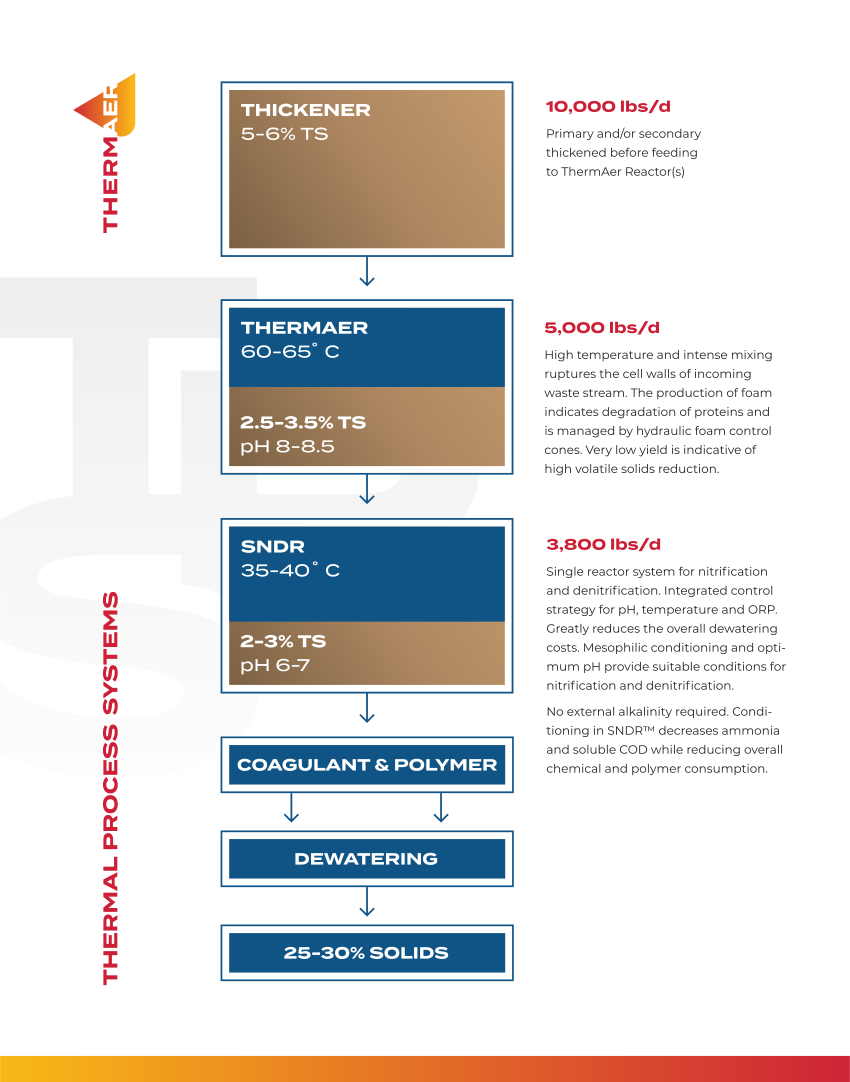
Overflow Schematic
Jet Aeration
Single reactor system for nitrification and denitrification. |
![]() |
Primary and/or secondary thickened before feeding
High temperature and intense mixing ruptures the cell walls of incoming waste stream
Greatly reduces the overall dewatering costs |
![]() |
||
LATEST NEWS & EVENTS
Hawaii WEA Annual Conference
Neal S Blaisdell Center
Honolulu, HI
February 7-8, 2012
Event Website »
CSWEA Innovative Conference
Holiday Inn
St. Cloud, MN
February 15, 2012
Event Website »
South Carolina WEA Annual Conference
Myrtle Beach Convention Center
Myrtle Beach, SC
March 10-13, 2012
Event Website »
Illinois WEA/AWWA Annual Conference
Crowne Plaza Hotel and Convention Center
Springfield, IL
March 19-22, 2012 **ThermAer Presentation-March 19**
Event Website »
WEF Residuals and Biosolids Conference
Raleigh Convention Center
Raleigh, NC
March 25-28, 2012
Event Website »
New Jersey WEA Annual Conference
Bally's Atlantic City
Atlantic City, NJ
May 13-18, 2012 - **ThermAer Presentation-May 16**
Event Website »
$109 / dry ton, Amazing!
In 2004, the City of Bowling Green, Ohio, installed Ohio's first TPS ThermAer Process expanding the plant capacity from 6 MGD to 10 MGD. This energy efficient process offered superior solids reduction and an odor-free operation. Doug Clark, Water Pollution Control Superintendent, calculated 2009 treatment costs at a remarkable $109 per dry ton. In addition, 38% total solids are coming off the centrifuge.